
PIER PLUS
PIER PLUS
Photo: PIER PLUS
5 May 2026
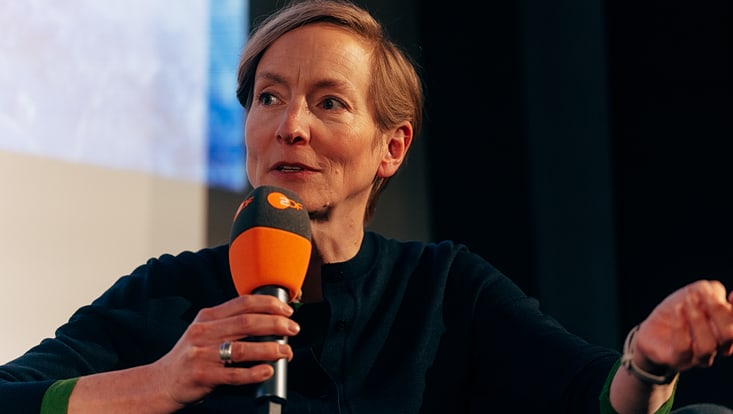
Photo: ZDF | Patrick Slesiona
The DFG Research Unit “The Promise of Security in Catastrophic Times” (PROMISE) has recently started its work. Its spokesperson, Prof. Dr. Ursula Schröder – who also leads the PIER PLUS profile “Conflict, Cooperation and Security” – heads this interdisciplinary group, which includes three PIER PLUS partners.
If you had to explain PROMISE to someone unfamiliar with the project: What is it about?
Ursula Schröder: In PROMISE, we investigate how democratic states and international institutions renegotiate and implement their promise of security amid overlapping crises – from pandemics and climate disasters to wars. We focus on the tension between societal expectations and efforts by states and international organizations to reconfigure their protection roles. Our key interest lies in which forms of protection are prioritized, who gets protected – and who is left out.
Why do we need a dedicated research unit on the “promise of security in catastrophic times” right now?
Schröder: We are facing an extraordinary clustering of crises that challenge decades of security policy: rising global war and violence, the intensifying climate crisis, and a deepening crisis of democratic governance in many states. Decision-makers must respond swiftly and find new ways to address these challenges. As a research unit, we analyze how these security policy decisions are justified, who benefits, and who is disadvantaged. We also explore how the understanding and practice of democratic security promises are evolving under conditions of multiple crises.
PROMISE is interdisciplinary and unites several Hamburg institutions, including multiple PIER PLUS partners. How do you collaborate in practice?
Schröder: PROMISE brings together colleagues from political science, sociology, communication studies, and human geography. Participating institutions include the University of Hamburg, Helmut Schmidt University/University of the Bundeswehr Hamburg (HSU), and the Institute for Peace Research and Security Policy at the University of Hamburg (IFSH), where I also serve as scientific director. These partners are also members in PIER PLUS’s “Conflict, Cooperation and Security” profile—no surprise, as cross-disciplinary and cross-institutional collaboration is central to PIER PLUS. Across eight research projects, we examine diverse protection practices: from state disaster management and UN humanitarian aid to the rejection of democratic security promises from the political right.
Can you name some examples of research projects?
Schröder: One HSU project examines how defense and security practices in Finland and the Baltic states have evolved since 2014 – in the context of Russia’s policies and the war against Ukraine. Another, involving IFSH, studies how the United Nations prioritizes humanitarian aid in crises and how “protection mainstreaming” approaches work in practice. A forward-looking University of Hamburg project, “Counter-Communities’ Protection Practices and Security Utopias in Catastrophic Times,” explores how marginalized communities—such as Black liberation movements, migrant solidarity networks, or feminist collectives—develop their own protection practices and security visions, having never been able to rely on liberal states’ traditional promises. This highlights that security can be organized not just top-down, but also reinvented from below.
What do you hope PROMISE will achieve long-term – scientifically and socially?
Schröder: Scientifically, we aim to make security research more interdisciplinary, comparative, and critical, showing that security in democracies is always also a matter of justice and participation. We hope our analyses will foster more inclusive changes to security promises and practices, openly addressing trade-offs and including groups often marginalized. Personally, I hope we can de-dramatize security debates – shifting from threat rhetoric to how we, as a democratic society, want to tackle crises in solidarity.

