PIER PLUS
PIER PLUS
Photo: PIER PLUS
8 April 2026

Photo: Isadora Tast/TUHH
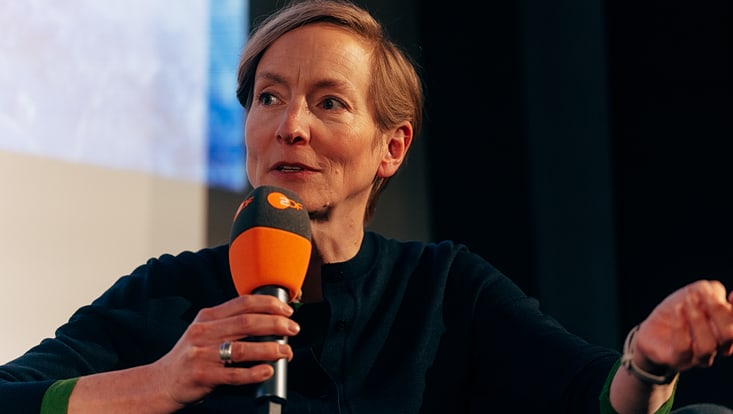
Recently, the Cluster of Excellence “BlueMat – Water-Driven Materials” has started its work. BlueMat is the first Cluster of Excellence at TU Hamburg and strengthens the PIER PLUS profile “PIER New Materials” – in addition to TUHH, eight PIER PLUS partners are involved in the cluster. The spokesperson for both the cluster and the PIER PLUS profile is materials physicist Prof. Dr. Patrick Huber.
The new Cluster of Excellence researches materials that harness water and its properties. What makes water so special in this context?
Patrick Huber: Water is a fascinating resource that we want to use to develop a completely new class of materials. Water is a very special medium: it has a whole range of anomalies, such as an exceptionally high surface tension. We want to make use of these special properties. Especially at the nanoscale, we can achieve astonishing effects with them, for example generating electrical energy when we force water into very small pores. Our Cluster of Excellence has four research areas in total: from mechanics and fluidics to photonics and energy materials. This broad spectrum of expertise drives us to pursue research in a truly interdisciplinary manner. That is why our cluster includes researchers from physics and chemistry as well as from engineering, mathematics, computer science, and even botany. These very different approaches to water as a driver of new materials are what make our cluster so special.
Why do we actually need new materials?
Huber: Many materials are based on complex chemistry. Very often, producing them requires elements that are harmful to the environment or very rare, or that occur in countries where the geopolitical situation is not straightforward. In addition, the complex structure usually also requires complex recycling processes. Our “Blue Materials,” by contrast, use water, a globally available resource. From a sustainability perspective, water is practically the fluid par excellence: it covers seventy percent of the surface of our planet, it is the working fluid on a planetary scale, it shapes the climate, the weather, and our lives – and we want to use that to rethink materials and, hopefully, establish a completely new era of materials science that accelerates the green energy transition and gives us more autonomy.
Which research areas of the Cluster of Excellence do you find especially appealing?
Huber: I really can’t decide, because each research area has its own appeal. In mechanics, for example, we want to develop autonomous sensors or actuators that move only through contact with water. In fluid transport, the goal is to integrate pumping mechanisms into materials that use only the capillary forces of water, similar to how water is pumped upward against gravity in trees, entirely without mechanical pumps. But photonics also has great potential to replace conventional chemistry with models from nature in order to develop, for example, self-tinting window materials. And the field of energy materials opens up incredible possibilities as well. Hydrovoltaics, for example, has a huge advantage over photovoltaics: we are not dependent on sunny weather, but can use the absolutely reliable tide cycle: surfaces get wet, dry, and wet again. In the process, charge is separated, which means electrical energy can be generated from it. That is also a great vision for me.
Let’s take a big step back: why did you personally choose physics as your profession?
Huber: Even as a teenager, I was curious about scientific questions. I was fascinated by the fact that an enormous variety of phenomena – from elementary particles to cosmic structures – can be described by a few fundamental principles such as symmetries and conservation laws. This underlying order behind complex phenomena is what led me to study physics. During my doctorate, I then worked extensively on materials, especially nanoporous structures and the behavior of liquids under spatial confinement. The special potential of water as a functional fluid became increasingly clear to me in the process. To this day, I am fascinated by this connection between fundamental physical principles and complex, application-oriented questions.
The cluster is also reflected in the PIER PLUS Profile “New Materials.” Can you tell us more about this?
Huber: With the successful recruitment of the cluster, we achieved at TUHH something that PIER PLUS has promoted from the very beginning: namely, the cooperative advancement of new ideas and projects across institutional and disciplinary boundaries. PIER PLUS also supported us during the application phase and was explicitly mentioned in the proposal as a structuring element. At the same time, the PIER PLUS profile is still somewhat broader than the cluster; there, we also bring together materials research beyond the future field of “water-based materials.” And because materials research is such a broad field, it also plays a role in Clusters of Excellence at the University of Hamburg: for example, in the study of written artifacts in “Understanding Written Artefacts” or in the cluster “CUI: Advanced Imaging of Matter,” which deals with matter on the atomic scale.