
PIER PLUS
PIER PLUS
Photo: PIER PLUS
7 May 2026
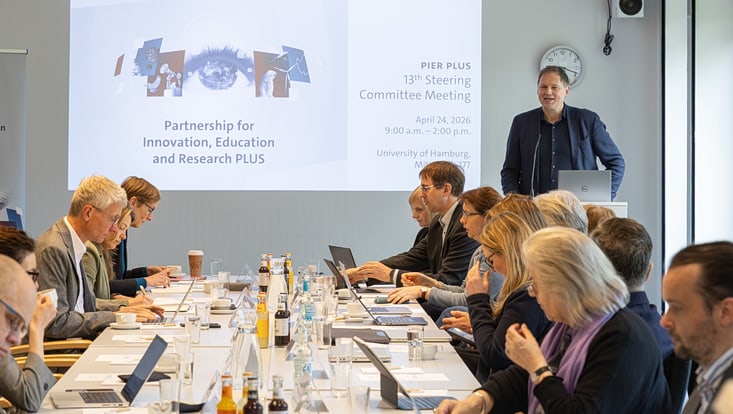
Photo: UHH / Yzer
At its 13th meeting in April 2026, the PIER PLUS Steering Committee addressed the topic of re-search security under the conditions of global political upheaval. The discussions focused on the exchange of institutional strategies, cybersecurity, and the development of shared structures for the Hamburg science community.
On April 24, 2026, the PIER PLUS partners met at the University of Hamburg for their 13th Steering Committee meeting to discuss strategies for a resilient and capable scientific community in times of geopolitical volatility. In his opening remarks, Prof. Dr. Hauke Heekeren, President of the University of Hamburg, emphasized the trustful dialogue within PIER PLUS, which is indispensable when addressing complex topics such as research security.
The thematic kickoff featured a keynote by Prof. Dr. Ursula Schröder, Director of the Institute for Peace Research and Security Policy at the University of Hamburg (IFSH) and Spokesperson of PIER Conflict, Cooperation and Security. Drawing on her expertise as a contributor to the 2025 German Science Council (Wissenschaftsrat) position paper on “Science and Security in Times of Global Political Upheaval,” she provided a sound basis for precisely defining the dimensions of research security. Her insights served as a vital starting point for a debate on the necessary framework conditions for future-proof collaborations.
The subsequent panels covered a wide spectrum, ranging from concrete compliance measures and individual risk assessments in international collaboration to measures in cyber security. Representatives from the partner institutions shared their practical experiences—whether regarding the handling of security-relevant contract research or the establishment of joint IT structures. It became clear that a proactive exchange of knowledge and experience is crucial for efficiently bundling competencies at the Hamburg site.
By focusing on this thematic area, the Steering Committee underscored the PIER PLUS partnership’s commitment to not only promoting excellent research but also actively shaping the structural prerequisites for responsible scientific practice in a volatile environment. The meeting highlighted the role of PIER PLUS as a vital platform that significantly strengthens the exchange between the various institutions, combining universities and non-university research organizations alike.

